
Five Ideas for Building a Stronger System of Care
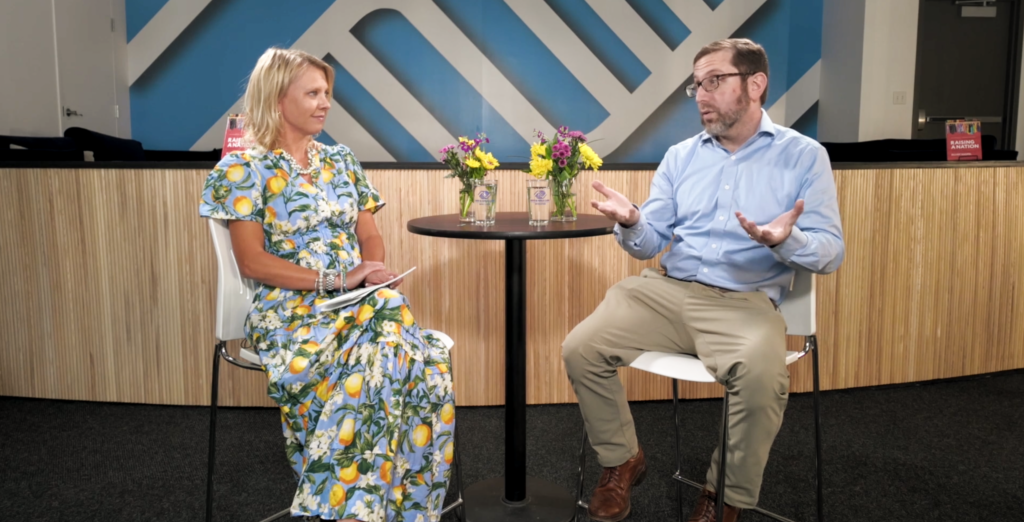
Five ideas from a conversation between childcare policy expert Elliot Haspel and Erin Porteous, CEO of Boys & Girls Clubs of Metro Denver, about care, community and what makes support work for children and families.
Children and families need care that is reliable, affordable, accessible and built around strong relationships. And that care doesn't stop being important when a child enters kindergarten. Afterschool programs, summer programs, schools, early childhood providers and other community organizations all play a role in creating the network of support that allows children and working families to thrive.
These ideas came into focus during a recent conversation between Erin Porteous, CEO of Boys & Girls Clubs of Metro Denver, and childcare policy expert and author Elliot Haspel at the Club de niños y niñas de Vickers. Together, they explored everything from the economics of care to the role relationships play in a child's life.
Elliot’s systems lens resonated with what Erin sees every day at Boys & Girls Clubs: families don’t experience child care, school, transportation, work and housing as separate issues. If we want care to work better, we have to design it around the realities of family life.
Five ideas from their conversation offer a framework for thinking about what a stronger system of care could look like.
1) Stability: One disruption can affect everything.
Why does stable care matter for working families? Stable care gives families a reliable foundation for work, school, and daily life. When one part of that system breaks down, the effects can quickly ripple across a family's life.
Erin shared the story of a Club member who suddenly stopped attending. Eventually, staff learned that her grandmother had become ill, her mother’s car had stopped working, her mother lost her job, and the child could no longer get to school or the Club.
For Erin, the story illustrates why care can't be viewed as a stand-alone service. A family's ability to access care is connected to everything else happening in their lives.
Care is infrastructure.
Transportation, housing, employment, school, and care don't operate independently from the perspective of a family. When one piece breaks down, the others can quickly follow. That means organizations serving children can't always limit their thinking to what happens within their own walls. Elliot described Boys & Girls Clubs and other community organizations as part of the informal networks of care that give families someone to call and somewhere to turn when plans fall apart.
2) Innovation: Design around families, not organizational boundaries.
Elliot challenged communities to think less in terms of separate systems and more about the experience of the family trying to plan their day. Communities can make care easier for families by coordinating services, sharing resources and designing care around a family's full day rather than expecting parents to navigate disconnected systems.
Erin pointed to one example in Commerce City. At the Club de niños y niñas Suncor, our organization partnered with University Prep Commerce City to use a building that previously sat largely dormant during the school day. Today, University Prep provides early learning and school-day programming in the building, while Boys & Girls Clubs of Metro Denver provides afterschool, school break and summer programming — creating more continuous support for families in one community space.
Instead of asking families to adapt to our systems, we should ask how our systems can adapt to families.
And how do you know it works for the most important customer? A child whose mom came to pick him up after his first day and heard: “Hey, Mom, can I stay longer?”
“At Boys & Girls Clubs, we talk about how we serve two customers. Our first customer is often the parents… But I’ll tell you the ultimate customer, and that is the kids.” — Erin Porteous
Good design has to work for both: it has to make a parent's life work and create an experience a child wants to return to.
3) Access: Care shapes the choices families can make.
Elliot described parents choosing jobs with lower pay or fewer benefits because the hours make child care possible.
Erin knew that reality personally. Her father was a Public School teacher in Denver, and her mother was a nurse. When Erin was young, her parents realized that after paying for childcare, her mother’s earnings barely changed the family’s finances. So, they rearranged their lives: her father worked days, and her mother took the graveyard shift.
Care isn't only a child's issue. It's also a workforce issue.
That's why Erin believes conversations about workforce participation and economic stability need to include care. When parents don't have reliable care for their children, the impact doesn't stop with one family. It can affect employers, neighborhoods, and the broader community.
In Boys & Girls Clubs of Metro Denver's 2025 parent research, 4 in 5 Club families said they wouldn't be able to keep their jobs without our organization.
Supporting working families means making sure they don't have to choose between earning a living and knowing their children are safe and supported.
4) Economics: Quality care has real costs.
Elliot explained that quality care is expensive because it depends heavily on people. There are limits to how many children one adult can responsibly care for, which means providers can't simply lower costs by serving more children with fewer people. Safe, enriching programs require trained staff, appropriate child-to-adult ratios, strong programming, facilities, meals, and enough operating hours to meet families' needs.
At Boys & Girls Clubs of Metro Denver, families pay up to $25 per month for afterschool programming—about $1.25 per day— while our annual cost to serve one child is $4,991.
That gap illustrates one of the fundamental tensions communities have to solve: Quality care is expensive to provide, but it can be out of reach for the families who need it.
Affordability and quality shouldn't have to compete.
Elliot argued that families have a limit to what they can reasonably pay, but providers can't reduce costs indefinitely without affecting quality. If we believe high-quality care benefits entire communities, then families shouldn't be expected to shoulder its true cost alone. Family contributions, philanthropy, public resources, and community partnerships can all be part of a sustainable model.
5) Relationships: Quality starts with people.
What does quality care look like for a child? At its core, quality care gives a child a stable, supportive relationship with an adult who knows them, believes in them and is there consistently over time.
One of Elliot Haspel's central points is that quality hinges on a "stable, warm, loving relationship between a caregiver and a child.”
Erin connected that idea to what she has seen in Clubs for years. Club members return year after year and build lasting connections with staff, mentors and coaches who remain in their lives.
“And we know the power of that, especially for young people who may not have those stable
relationships at home.” — Erin Porteous
Systems matter. Funding matters. Access matters. But ultimately, those systems exist to make something profoundly human possible: a child having a trusted adult who continues to show up.
That offers a useful measure for any conversation about improving care: Are we creating the conditions for children to build the relationships they need?
Quality care has to work for the whole family
Building a stronger system of care isn't the responsibility of any one organization. It requires schools, childcare providers, afterschool organizations, employers, philanthropists, policymakers, and families to think beyond traditional boundaries and consider how all these pieces fit together.
Taken together, Elliot's systems lens and Erin's on-the-ground examples point to a broader challenge: Stop thinking about care as a series of separate programs and start thinking about the complete network of support children and families need every day.
Because quality care must do two things at once: make family life possible and give children relationships and experiences they want to return to.
Many of these ideas are explored further in Elliot Haspel's Raising a Nation: 10 Reasons Every American Has a Stake in Child Care for All.